

01
Overview
Finding new markets for a technology in its infancy
A six-week Stanford innovation engagement in late 2015. I joined a group of Innovators partnered with Autodesk, tasked with finding markets for two of their products outside the customer base they already had: Memento, a 3D reality-capture tool that later became ReMake, and Project Play, an experience-creation tool for building interactive walkthroughs.
Photogrammetry was still early then. Capture was slow, results were rough, and almost nobody outside of surveying and a handful of game studios was using it for anything serious. The question was where else it could go.
02
Challenge
Two use cases nobody had asked for
Autodesk had already found a couple of successful uses for Memento outside their existing user base and wanted more. Anything that brought a new industry in would also bring that industry into the Autodesk ecosystem.
After seeing what the capture technology could actually do, I proposed two directions of my own: forensics, and fire response. Neither was on the list. Both turned out to be worth three weeks of interviews.
03
Process
Three weeks of interviews
I spoke with a retired FBI forensics expert, a chief at the San Francisco Fire Department, and crew members at a local station I visited in person, alongside developers at Electronic Arts and Ubisoft. The point was to find out whether the use cases I'd imagined survived contact with the people who would actually use them.
What a fire crew could use it for
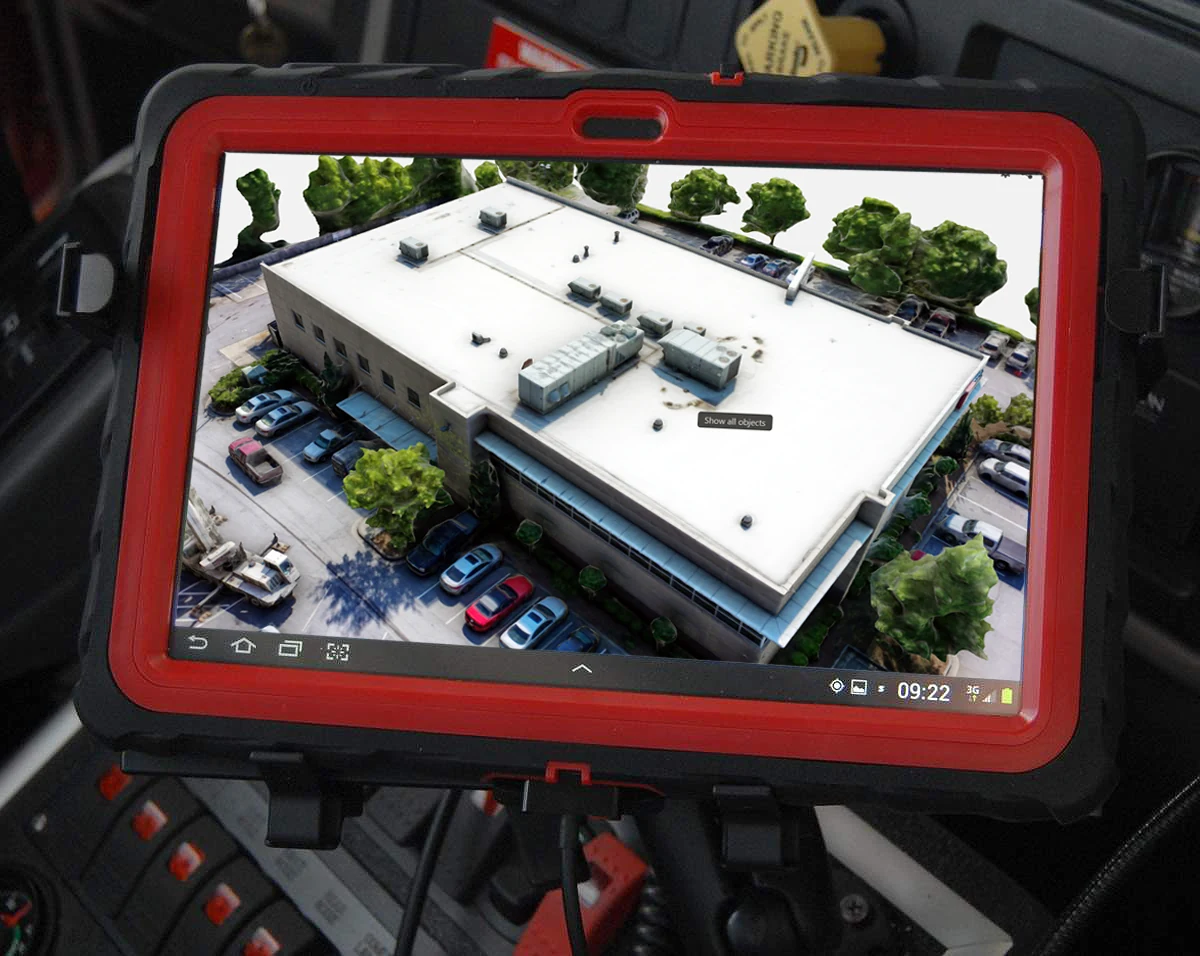
The clearest fire-side use was giving a crew a 3D capture of a building before they arrived at it. I mocked this up as a Mobile Dispatch Terminal: a reality-captured model of a real building, on the ruggedized tablet already mounted in the cab.
The forensic uses stacked up quickly once I started asking. Documenting an environment at each stage of an investigation. Documenting evidence in place. Turning captured scenes into training situations. 3D printing tyre tracks, shoe prints, and other impression evidence so it could be preserved and shared rather than described.
Putting the photograph where it was taken
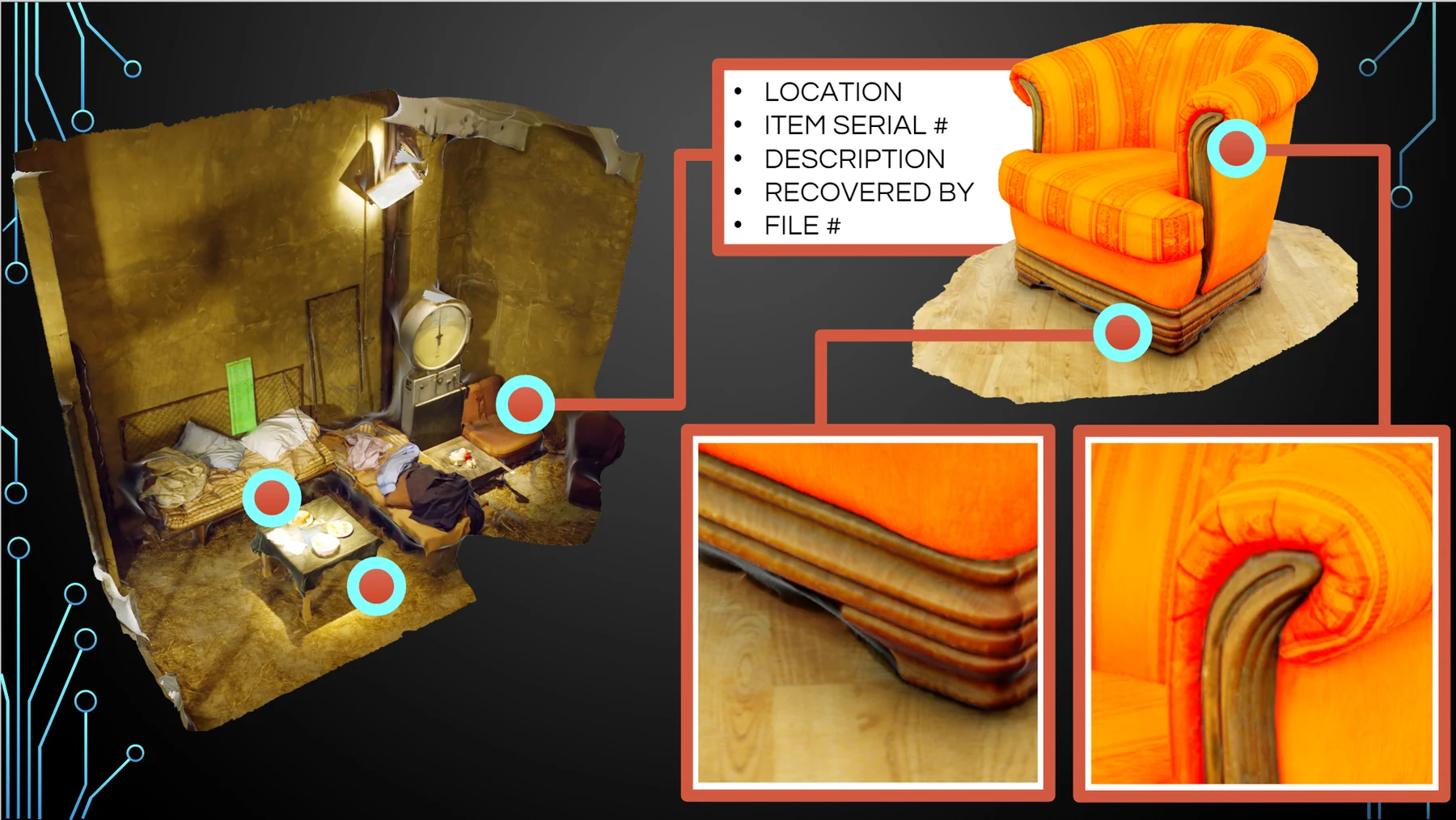
The idea I still think was the strongest came out of the forensics conversations. An investigator photographs a scene in threes: a wide shot, a mid shot, and a close-up, so that whoever reads the file later can work out where the close-up actually is. That's three photographs doing the job of one piece of spatial information.
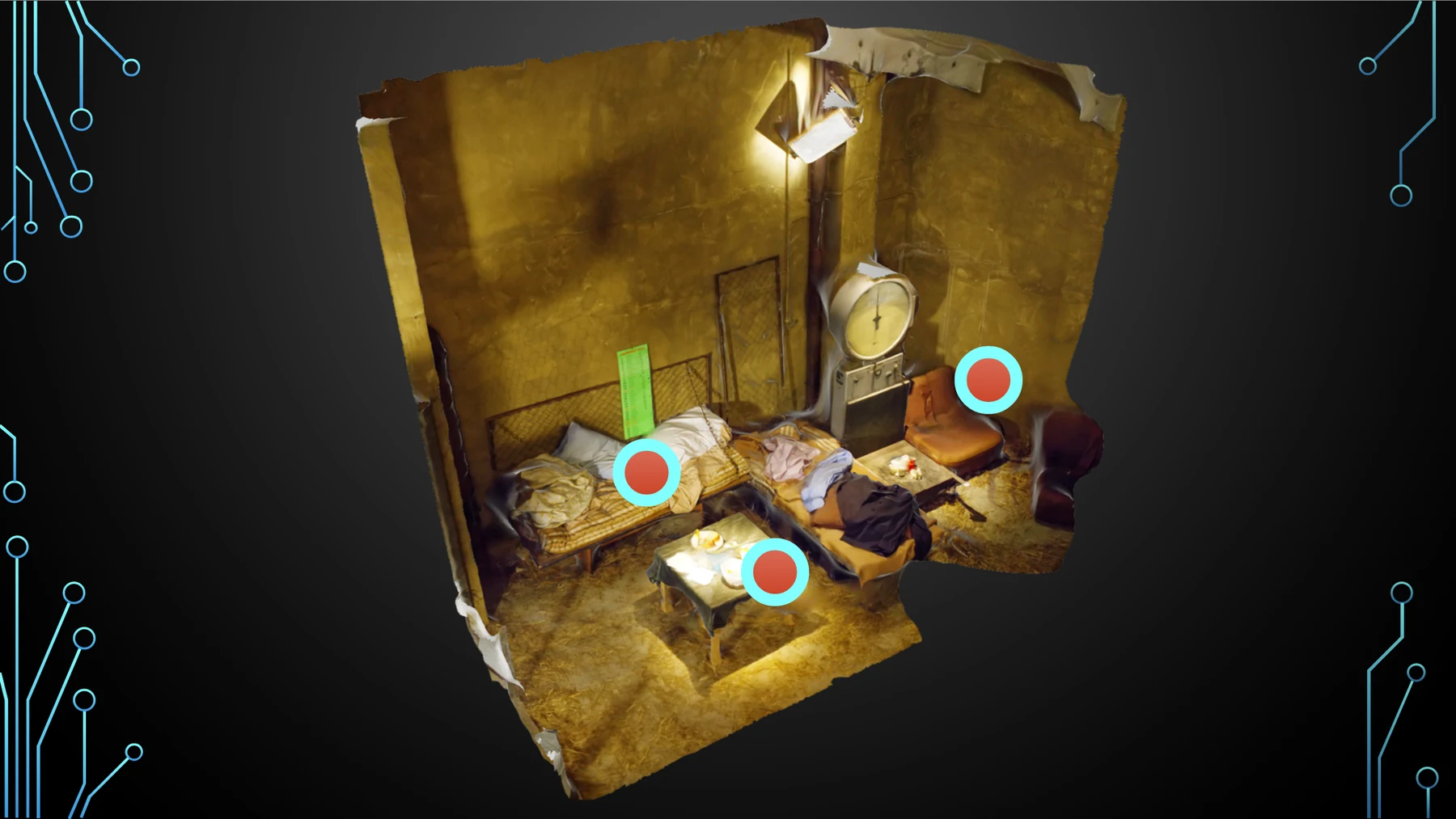
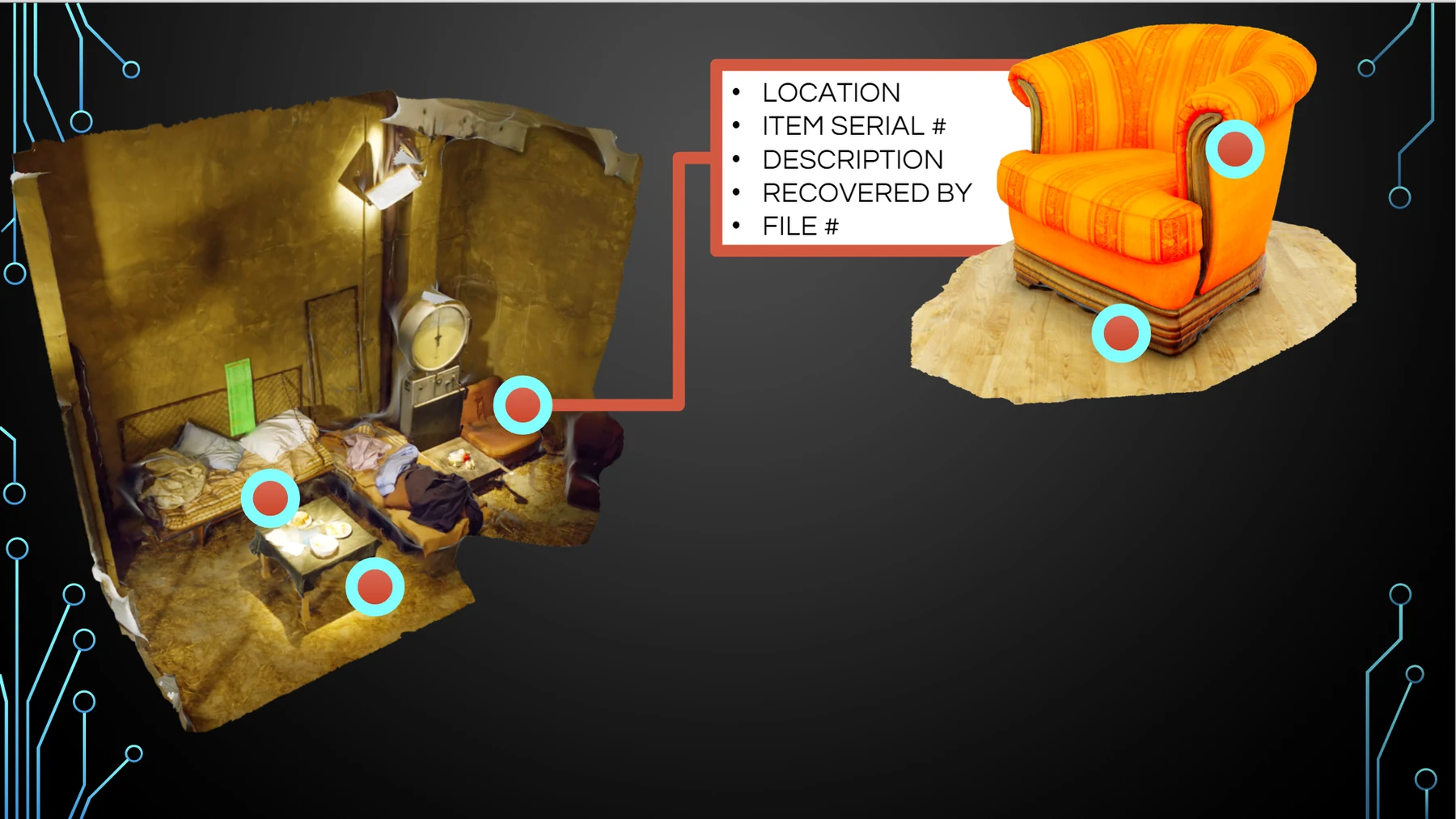
If the scene is captured in 3D, the photograph can just live where it was taken. I mocked this up in Project Play: a captured room with interactive hotspots, where opening a hotspot gives you the evidence record and the captured object, and the object has its own hotspots that open the investigator's own detail photographs of those exact spots.
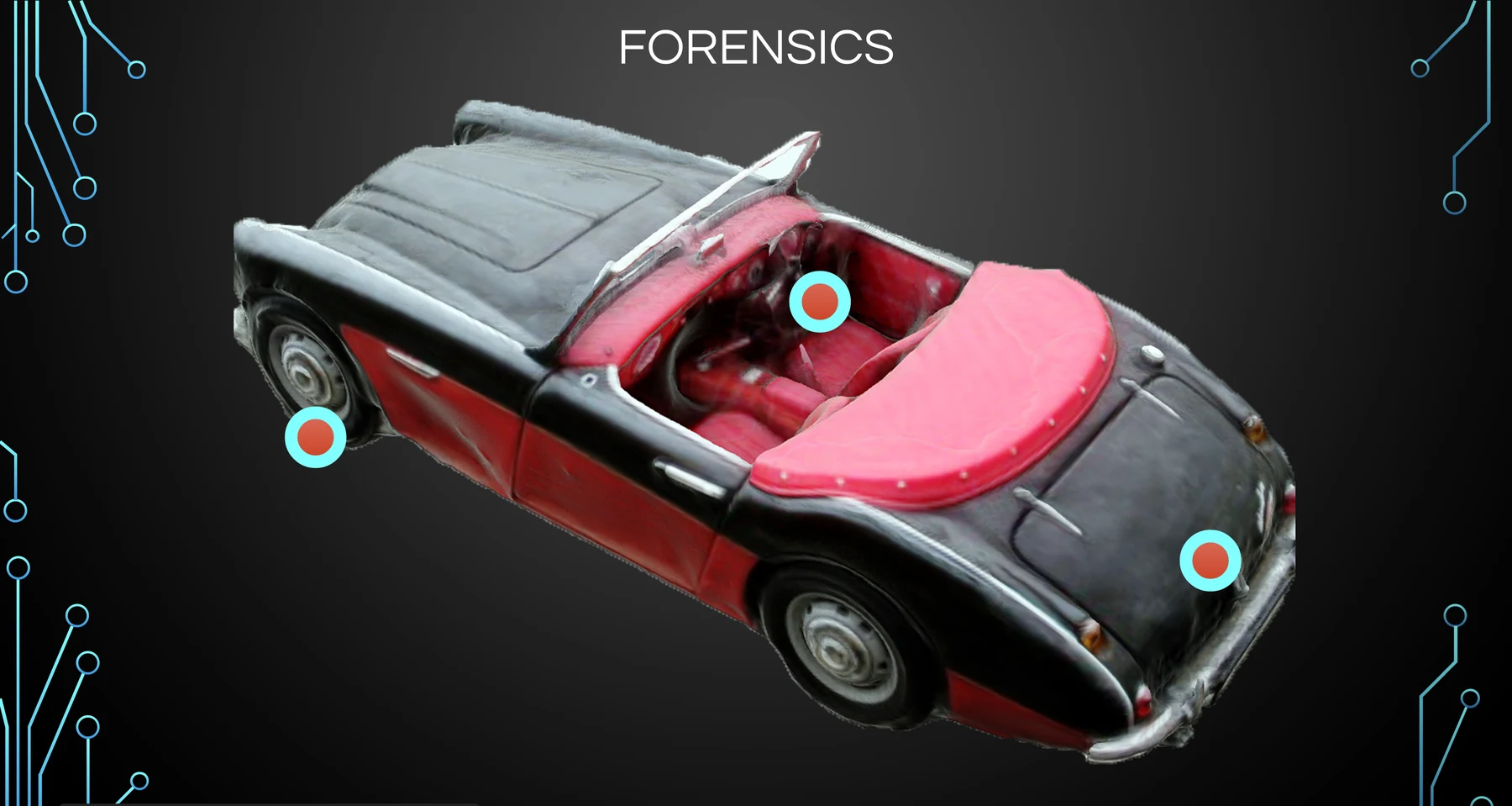
The same idea worked on a vehicle. Tap a point on the car and you get the photograph taken from that point, with the case information attached.
What the game studios said
The game-development side was a different conversation, because those studios were already doing this. Both were on Agisoft PhotoScan, which ran over three thousand dollars a seat. One had tried an earlier version of Memento and given up on it. The other had tried Agisoft, disliked the interface, and preferred how simple Memento was to use.
Two concerns came up on both sides: IP privacy, since captured assets would be going to somebody else's cloud, and queue times waiting for models to come back from it.
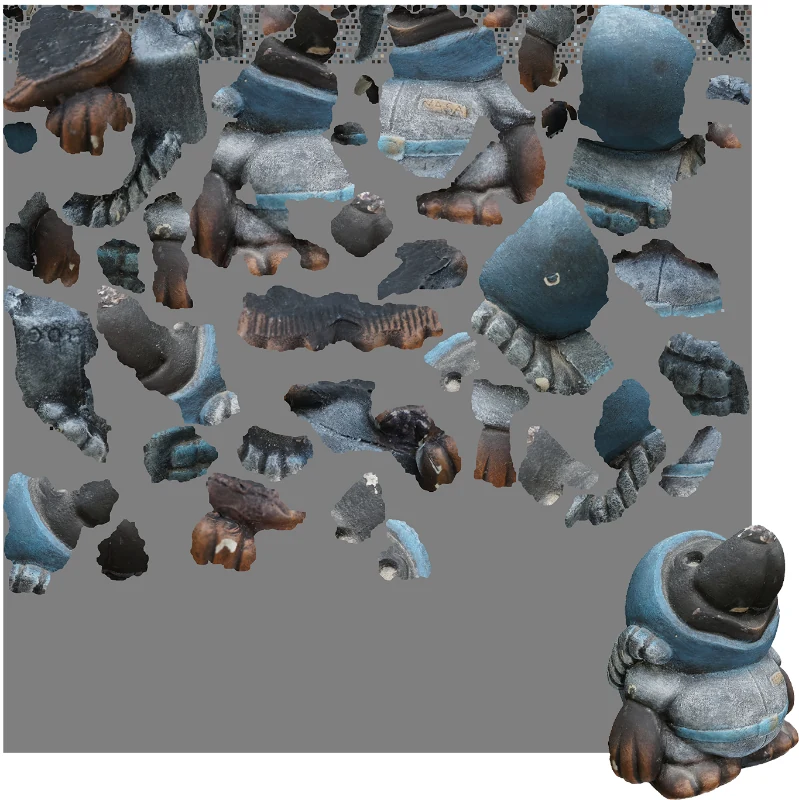
The most interesting gap was materials. Studios wanted to pull textures off captured models, not just geometry, and Memento's texture output wasn't usable for that — pieces of the model scattered across the sheet with wasted space between them, when what an artist needs is everything grouped tightly. That would have been the feature worth building.
04
Outcome
Right idea, wrong decade
I wrote up the findings as a report and presented it: use cases across both industries, adoption budgets from a local field office up to a national rollout, and the specific product gaps that would need closing first.
Nothing came of it at Autodesk. They were interested in customers outside their ecosystem, but forensics and fire response were further outside it than they were comfortable going.
The direction turned out to be right. Photogrammetry is now used regularly for crime scene and accident documentation, adopted for exactly the reasons that made it appealing in 2015: it's cheap, it doesn't need specialized equipment, and it captures detail a tape measure can't. VR walkthroughs built on captured scenes are used to explain evidence to lawyers, judges and juries, which is the Project Play use case I mocked up. It just took another ten years, and it wasn't Autodesk who built it.
What it changed for me
This engagement was also where I was formally introduced to design thinking, human-centred design, and product design. I had been a game designer for over a decade at that point. Within a few years I had moved into product and experience design entirely. This was the turning point.